

Last Updated: November 13, 2026
Quick Summary
The electric van battery replacement cost depends on battery capacity, parts, labour and VAT, so no single figure fits every model. Always request an itemised quote for your exact van, and run diagnostics first, because module repair or a warranty claim often costs far less than a full pack.
- Battery capacity in kWh is the biggest cost driver, rising from small city vans to chassis cabs.
- A transparent quote separates parts, specialist labour and VAT, so push for that breakdown.
- Diagnostics should always come first, as a faulty module can trigger a false replace-pack recommendation.
- With state of health above roughly 80% and one faulty module, repair the module rather than the pack.
- Leasing spreads a large battery bill into a fixed monthly rental with a fresh battery under warranty.
Table of Contents
- Why Electric Van Battery Replacement Costs Matter for UK Fleets
- Typical Electric Van Battery Replacement Costs in 2026
- Electric Van Battery Repair or Replacement: Which Option Fits Your Fleet?
- How an Electric Van Battery Health Check Can Prevent Costly Surprises
- What Your Electric Van Battery Warranty Actually Covers
- Electric Van Leasing for Businesses: A Smarter Route Than Paying for Replacement
- Managing Downtime and Whole-Life Costs Across Oxfordshire Fleets
- Next Step: Review Your Fleet's Battery Strategy with OVL Group
- Frequently Asked Questions
Why Electric Van Battery Replacement Costs Matter for UK Fleets
An electric van battery replacement cost guide matters because the traction battery is the single most expensive component in any electric vehicle.
Fleet managers ask us about this constantly. The fear is understandable. A diesel engine swap is a known quantity. A high-voltage battery pack is not.
Here is the good news. Full pack replacement is rarely the first answer.
Typical Electric Van Battery Replacement Costs in 2026
No honest article can give you a single figure, and we will not invent one. Replacement costs vary too widely between models, battery capacities and suppliers.
What we can do is show you the cost structure. That is what actually helps you budget.
Cost Estimates by Battery Capacity and Van Size
Battery capacity is measured in kilowatt-hours (kWh), and it is the biggest cost driver. A larger battery pack needs more cells, more labour and more specialist handling.
| Van size | Typical battery capacity | Relative replacement cost |
|---|---|---|
| Small city van | Around 40-50 kWh | Lowest |
| Medium panel van | Around 60-75 kWh | Moderate |
| Large panel van | Around 80-90 kWh | High |
| Chassis cab or minibus | 90 kWh and above | Highest |
Treat this as a ranking, not a price list. Always request an itemised quote for your exact model.
Breaking Down the Quote: Parts, Labour and VAT
A transparent quote separates three things:
- Parts: the new or refurbished battery pack, plus any replacement parts such as mounting hardware or coolant.
- Labour: specialist technician time for high-voltage system work, plus diagnostic checks and software configuration.
- VAT: chargeable on most commercial battery work. Ask whether your business can recover it.
Watch out: a quote that gives one lump sum without splitting parts and labour is hiding something. Push for the breakdown before you commit.
Electric Van Battery Repair or Replacement: Which Option Fits Your Fleet?
Repair usually wins when the fault sits in a single battery module or in the surrounding high-voltage system. Replacement wins when degradation is spread across the whole pack. The decision is best guided by diagnostic data.
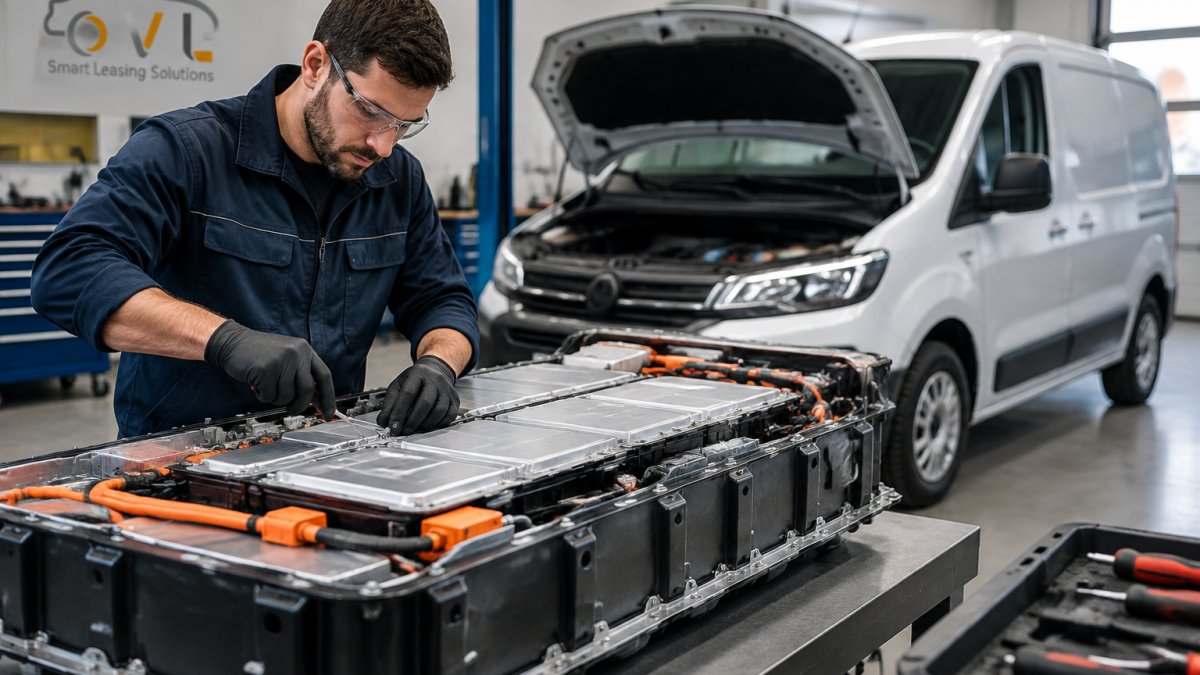
Modern electric van packs are often modular, so a specialist may be able to test individual modules and replace only the weak ones rather than the whole pack.
How diagnostics separate a module fault from a pack fault
A battery health check typically looks at the following before a replacement is quoted:
- State of health (SoH): the pack's remaining capacity as a percentage of its original rated capacity.
- Cell balance: how evenly the modules hold voltage. A single weak module drags the whole pack down and can trigger a false "replace pack" recommendation.
- Internal resistance: rising resistance points to ageing cells and heat damage, and it shows up before outright failure.
A common pattern is a van that arrives with a dashboard warning and a dealer quote for a full pack, when the actual fault is a failed module or a faulty ancillary part. Diagnostics cost a fraction of a pack and should always come first.
The decision framework we use
- SoH above roughly 80% with one faulty module: repair the module. The rest of the pack still has useful commercial life.
- SoH between 70% and 80% with range loss affecting daily routes: weigh module repair against the remaining life of the pack, and factor in how long you intend to keep the van.
- SoH below 70% with range loss affecting daily routes: full pack replacement or vehicle replacement. At this point module repair is throwing money at a pack that is nearing the end of its working life.
New, refurbished and remanufactured packs
When replacement is the answer, you have three routes, and the price and risk differ sharply:
- New pack: manufacturer or approved-supplier unit, full warranty, highest cost. The safe choice for a van you intend to keep for years.
- Refurbished pack: used cells tested and reconditioned to a stated SoH, usually with a shorter warranty. Cheaper, but you need the SoH in writing before you commit.
- Remanufactured pack: worn packs stripped and rebuilt to a defined specification, often with a workmanship guarantee. Sits between the two on price and risk.
Repair versus replacing the van
For a fleet manager, the real comparison is not repair versus replacement of the battery, it is repair versus replacing the vehicle. A four-year-old van facing a full pack bill may still be the cheaper asset once you account for the capital cost of a new vehicle, the downtime of swapping it in, and the residual value of the old van. Our whole life cost analysis for vans sets out the method, and our breakdown of electric versus diesel fleet maintenance covers the servicing side of the same calculation.
How an Electric Van Battery Health Check Can Prevent Costly Surprises
An electric van battery health check is a diagnostic test that measures a pack's condition before replacement is considered.

A common mistake is waiting for the dashboard warning light. By then, degradation has usually been building for months.
Book a check when you notice:
- Driving range dropping on routes you know well
- Slower rapid charging sessions
- Regenerative braking feeling weaker
Testing before replacement also protects you at resale. A documented battery health report is worth more than a verbal assurance.
What Your Electric Van Battery Warranty Actually Covers
Manufacturer warranties on the traction battery vary, and the terms that apply depend on the manufacturer and model year. Read your own policy for the exact figures, because they differ by manufacturer and by model year. The two numbers that matter are the degradation threshold, the SoH below which the manufacturer will act, and the mileage cap, which commercial vans often reach long before the calendar limit.
What is usually covered
- Outright failure of the pack or its internal components under normal use.
- Excessive degradation below the threshold stated in your policy, measured by an approved diagnostic.
- Battery management system faults that are not caused by misuse.
What is usually excluded
- Damage from missed software updates.
- Faults traced to non-approved charging equipment.
- Wear the manufacturer classes as normal.
Keep every service record. Warranty claims on an electric vehicle battery live or die on documented maintenance, and a missed scheduled check is an easy reason for a manufacturer to decline.
Approved repair and parts questions to ask
Before you authorise any work, get answers in writing to these questions:
- Is the repair being carried out by an approved technician, and will it preserve the remaining warranty?
- What is the warranty term on the replacement pack, module or part?
- What workmanship guarantee applies to the labour?
Watch out: a repair carried out outside the approved network can void the remaining battery warranty, even if the work itself is sound. Confirm the position before the van goes on the ramp.
Finance and leasing implications
If the van is on finance or leased, the battery is not yours to replace unilaterally. Check the agreement before authorising work, some contracts require approved repair and specify who bears the cost of a pack that fails outside warranty. On a lease, the vehicle usually returns to the provider at the end of term, so a degraded battery is the provider's residual-value risk, not yours.
Where cover falls short
When the warranty does not apply, the replacement interval question returns. That is where leasing changes the maths. Rather than absorbing a large one-off capital outlay and the commercial downtime while the van is off the road, a lease spreads the cost into a fixed monthly rental and puts a fresh battery under warranty on your drive. The same logic applies across our electric and hybrid leasing range, and our guide to fleet leasing versus fleet management for small business sets out the cost and tax differences.
Electric Van Leasing for Businesses: A Smarter Route Than Paying for Replacement
Electric van leasing can shift battery replacement risk away from the business's balance sheet, depending on the agreement. You pay a fixed monthly rental, and the vehicle returns to the provider at the end of term.
Compare the two routes honestly:
- Buying a replacement pack: large one-off capital outlay, plus commercial downtime while the van is off the road.
- Leasing a new electric van: predictable monthly cost, a fresh battery under warranty, and no resale risk on a degraded asset.
For a fleet manager facing a large battery bill on an older van, leasing may be worth comparing against a replacement pack. You can check our van leasing special offers and vehicle leasing special offers to see what is currently available.
The same logic applies across our electric and hybrid leasing range. If you are weighing the two models directly, our guide to fleet leasing versus fleet management for small business sets out the cost and tax differences.
Managing Downtime and Whole-Life Costs Across Oxfordshire Fleets
Commercial downtime is the hidden cost nobody quotes for.
Plan replacement around your busiest periods, book diagnostics in advance, and consider keeping a spare van available during high-voltage work.
Whole-life cost analysis is how you see the full picture.
If charging costs are your next question, our guide to managing electric fleet charging costs covers smart charging and infrastructure planning.
Next Step: Review Your Fleet's Battery Strategy with OVL Group
Battery replacement does not have to be a budget shock. Test early, read the warranty, and compare repair against replacement before you sign anything.
At OVL Group, we help fleet managers build a battery strategy that fits their budget. Our team offers:
- Tailored leasing across cars, electric vehicles, vans and minibuses
- Whole life cost analysis covering finance, fuel, servicing, maintenance and repairs
- Dedicated account management from first quote to renewal
Browse our current Ford leasing deals to see what is available on the models your drivers already know.
The challenge is simple: the next battery failure on your fleet is a question of when, not if.
Frequently Asked Questions
How much does it cost to replace an electric van battery in the UK?
Replacement costs vary widely depending on battery capacity, van model and whether you choose a new, refurbished or remanufactured pack. Smaller 40kWh packs cost less than larger 75kWh units, and labour rates differ by workshop. Ask for an itemised estimate covering parts, labour and VAT. For many businesses, comparing that outlay against electric van leasing for businesses is the more useful calculation.
How long do electric van batteries last before replacement is needed?
Most traction batteries in modern electric vans are designed to last many years of normal use, and degradation is gradual rather than sudden. Range loss of a few per cent per year is typical. A regular electric van battery health check, which measures state of health, helps you spot decline early and plan replacement or remarketing before a pack fails. Charging habits and thermal management both influence how quickly capacity drops.
Is an electric van battery covered by warranty?
Most manufacturers provide a separate electric van battery warranty, often lasting several years and linked to a retained capacity threshold. Cover usually applies to defects rather than normal degradation below that threshold, so read the terms carefully. Keep service records and avoid unauthorised repairs, which can void cover. If your warranty is close to expiring, a health check gives you evidence before the cover ends.
Can an electric van battery be repaired instead of replaced?
Sometimes. Modular battery systems allow individual modules or cells to be swapped, which can be cheaper than a full pack replacement when the fault is isolated. A diagnostic check identifies whether the issue is a single module, the battery management system or wider degradation. Where repair is not viable, refurbished or remanufactured packs offer a middle ground between new and full replacement, though you should confirm warranty terms on any refurbished unit.